Noah Pacik-Nelson
Share
We get asked this question a lot: "How does BootLoop compare to GitHub Copilot or Claude? Can you give me something to show management?"
It's a fair question. Your VP wants a number. Your procurement team wants a comparison chart. And the honest answer starts with something that sounds like a dodge but isn't: these tools are solving fundamentally different problems.
GitHub Copilot is excellent at what it does. It autocompletes code in your IDE, suggests functions, and can save a web developer up to 55% of their time on repetitive tasks. Claude is a brilliant general-purpose reasoning engine. For high-level software, both are seriously useful.
But firmware isn't high-level software. And the moment you try to use a general-purpose AI coding assistant on embedded work, the wheels come off in ways that are hard to see until you're deep into debugging.
Here's why.
General-purpose AI doesn't know your hardware
Copilot and Claude have never read your datasheet. They don't know that your STM32H7 has a dual-bank flash architecture that requires specific unlock sequences, or that your TI MSPM0 has a DMA channel configuration that differs from every other chip in the family. They don't know that your Altium schematic routes SPI_MOSI to a non-default pin.
These tools are trained on the average of thousands of public code repositories. They see patterns in text - they don’t see your specific hardware. They don’t see how all the different chips are connected to form a system that is uniquely yours.
AI can't debug what it can't see
In 2025, at least 166 recalls by automakers were due to software issues, an all time high and a stat that has been rising rapidly for over 6 years. That's 15 million cars.The embedded industry is shipping more complex products with fewer qualified people to write the firmware. The cost of "close enough" code is measured in safety incidents, not GitHub issues.
Here’s the issue: Copilot generates code in your editor. It looks about right so you set up your toolchain, compile it, and flash it to your board. The chip doesn’t initialize, or the SPI clock is running at half the expected frequency, or any number of other issues occur.
It’s because the entire test and validation loop - the part that actually matters - happens outside the world the AI model lives in. These models are designed to output the most likely thing. It will always look like it will work. But the model never sees the hardware. It never sees the serial output. It never sees the oscilloscope trace. It never sees any of the things that you see as an engineer to confirm that things are working correctly. It generates code in a vacuum and hopes for the best.
What firmware teams actually need
The firmware development bottleneck isn't typing speed. It's the iteration cycle: write code, compile, flash, test on hardware, observe behavior, debug, repeat. A typical firmware project spends 50% of its schedule on debugging and testing alone. That's where the time goes. That's where the money goes.
With 80% of embedded engineering job postings going unfilled for months to years and over 99,000 open firmware roles in the US alone, the problem isn't that your engineers type too slowly. It's that there aren't enough of them, and each one spends half their time in a testing loop that no general-purpose AI can help with.
Where BootLoop is different
We built BootLoop specifically to close this gap. Not by generating tons of code in an editor, but by owning the entire firmware development loop.
BootLoop ingests your actual hardware context. It reads your datasheets, parses your schematics, and understands your Altium projects. It knows your chip's register map, your pin configuration, and your peripheral layout. It writes code for your specific target, not generic code that might work on something similar.
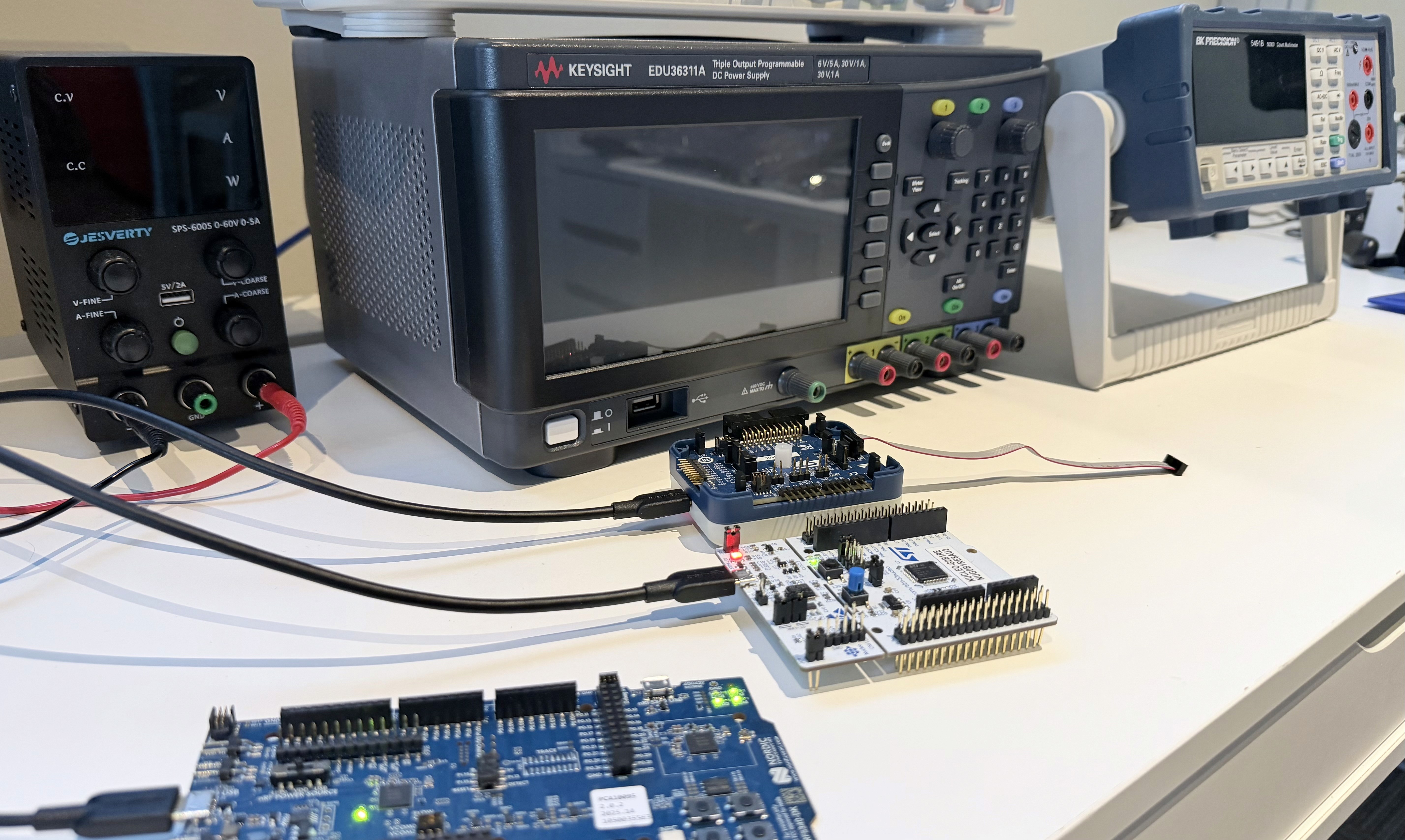
BootLoop compiles, flashes, and tests on real hardware. When we say hardware-in-the-loop, we mean it literally. The agent compiles against your toolchain (Zephyr, VxWorks, ESP-IDF, Yocto, bare metal - we support dozens), flashes to your connected board, monitors the RTT console, connects to oscilloscopes and logic analyzers, and iterates until the behavior matches the spec. Average time to a hardware-tested driver: 8.5 minutes.
The ROI conversation
So when management asks "what's the ROI compared to Copilot," here's how to frame it:
GitHub Copilot costs $19/user/month for Business and optimizes typing speed for general software development. The reported productivity improvement is 20-55% on code completion tasks. For your web team, that's real value.
But for firmware, the bottleneck isn't code completion. It's the full cycle: understanding the hardware, writing correct register-level code, compiling for the right target, flashing, testing, debugging, and iterating. Copilot touches maybe 10% of that workflow. BootLoop touches all of it.
The real comparison isn't BootLoop vs. Copilot. It's BootLoop vs. the cost of:
An unfilled firmware engineering position that takes 3-6 months to hire for
A senior embedded engineer spending 75% of their time doing testing, validation, and debugging
A product delay because the firmware isn't ready when the hardware is
A field recall because a buffer overflow slipped through QA and caused devices in the field to crash
We've written firmware for over 850 different chips, processed more than 1,200 datasheets, and generated over a million lines of production firmware. Our users report root-cause analysis that's 22.5x faster than manual debugging.
That's not an incremental improvement in typing speed. That's a fundamentally different capability.
The bottom line
Copilot and Claude are great tools. We use them ourselves for plenty of things. But they were built for a world where code runs on servers and the feedback loop is a unit test. Firmware runs on hardware, and the feedback loop is testing at the bench.
If you're building software that never touches a chip, use Claude. It's great.
If you're building firmware that has to work on real hardware, in real time, with real constraints, come talk to us. We'd love to show you what BootLoop can do on your actual board, with your actual toolchain, in under ten minutes.
Book a demo and see for yourself.
-- Noah